
ICJ: Israel must let Gaza aid in, work with UN agency for Palestinians
The UN's top court has issued a non-binding ruling to the effect that Israel must allow adequate aid into Gaza and cooperate with UNRWA, the UN body tasked with aiding Palestinians refugees. Israel has banned UNRWA, insisting it has been infiltrated by Hamas.
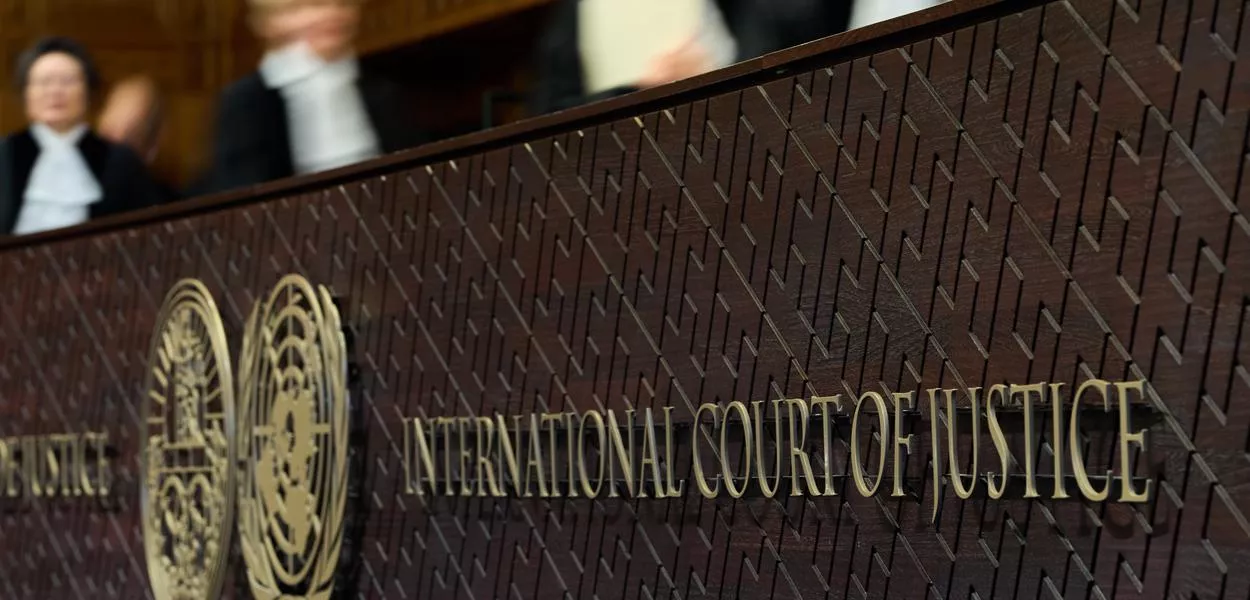
The Hague (dpa/AFP/AP) – Israel must allow sufficient humanitarian aid into the Gaza Strip and cooperate with the UN Relief and Works Agency for Palestine Refugees in the Near East (UNRWA), according to an advisory opinion from the International Court of Justice (ICJ).
The opinion handed down on Wednesday states that Israel, as an occupying power, is obliged to care for the population of the Gaza Strip. The opinion from the UN's highest court in The Hague is not binding.
Israel has prohibited UNRWA from operating in the Gaza Strip since January. And from March to May, Israel essentially stopped allowing aid into the Gaza Strip.
Since the fragile ceasefire came into force on October 10, Israel has resumed allowing aid transports into the blockaded coastal area. However, according to the United Nations, this is far from sufficient to support the suffering population.
ICJ: Israel must not use starvation
"The court recalls Israel's obligation not to use starvation of the civilian population as a method of warfare," ICJ President Yuji Iwasawa said.
The UN General Assembly asked the court last year to give an advisory opinion on Israel's legal obligations after the country effectively banned the UN agency for Palestinian refugees, the main provider of aid to Gaza, from operating in the territory.

Israel "is under the obligation to agree to and facilitate relief schemes provided by the United Nations and its entities, including UNRWA," Iwasawa said.
Israel has denied it has violated international law, saying the court's proceedings are biased, and did not attend hearings in April. However, the country provided a 38-page written submission for the court to consider.
The advisory opinion comes as a fragile US-brokered Gaza ceasefire agreement, which took effect on October 10, continues to hold.
Advisory opinions carry significant legal weight and experts say the case could have broader ramifications for the UN and its missions worldwide.
A ceasefire to consider
The proceedings predate the current fragile US-brokered Gaza ceasefire agreement, which took effect on October 10, and aims at ending the two-year war in the Palestinian enclave. Though still in effect, the shaky truce was tested earlier this week after Israeli forces launched a wave of deadly strikes, saying Hamas militants had killed two soldiers.
Under the agreement, 600 humanitarian aid trucks are to be allowed to enter daily.
The UN has announced plans to ramp up aid shipments into Gaza. On Monday, Hamas chief negotiator Khalil al-Hayya told Egypt's Al-Qahera News that Israel has complied with aid deliveries per the ceasefire agreement.
During the hearings in April, Palestinian Ambassador to the Netherlands Ammar Hijazi told the 15-judge panel that Israel was “starving, killing and displacing Palestinians while also targeting and blocking humanitarian organizations trying to save their lives.”
The UNRWA ban

Israel's ban on the UN agency in Gaza, known as UNRWA, came into effect in January.
The organization has faced increased criticism from Israeli Prime Minister Benjamin Netanyahu and his far-right allies, who claim the group is deeply infiltrated by Hamas. UNRWA rejects that claim.
In March, Israel cut off all aid shipments for three months, leading to severe food shortages in the Palestinian territory. Eventually, Israel allowed in some aid while pushing forward with a highly criticized plan to shift aid distribution to the Gaza Humanitarian Foundation, a private US-backed group. Conditions continued to worsen and international food experts declared a famine in parts of Gaza in August.
Israel has claimed there was enough food in Gaza and accused Hamas of hoarding supplies.
GHF has suspended its operations after the latest ceasefire was reached.
An advisory opinion
Advisory opinions issued by the UN court are described as “nonbinding” as there are no direct penalties attached to ignoring them. However, the treaty that covers the protections that countries must give to UN personnel says that disputes should be resolved through an advisory opinion at the ICJ and the opinion “shall be accepted as decisive by the parties.”
The UN General Assembly asked for the ICJ's guidance in Dec. 2024 on “obligations of Israel … in relation to the presence and activities of the United Nations … to ensure and facilitate the unhindered provision of urgently needed supplies essential to the survival of the Palestinian civilian population.”
“We cannot let states pick and choose where the UN is going to do its work. This advisory opinion is a very important opportunity to reinforce that,” Mike Becker, an expert on international human rights law at Trinity College Dublin, told The Associated Press ahead of the hearings in April.
The ICJ has issued other advisory opinions on Israeli policies. Two decades ago, the court ruled that Israel's West Bank separation barrier was “contrary to international law.” Israel boycotted those proceedings, saying they were politically motivated.
In another advisory opinion last year, the court said that Israel's presence in the occupied Palestinian territories is unlawful and called on it to end, and for settlement construction to stop immediately. That ruling fuelled moves for unilateral recognition of a Palestinian state. Israel condemned the decision, saying it failed to address the country's security concerns.
Arrest warrants for Netanyahu
Last year, another tribunal in The Hague, the International Criminal Court, issued arrest warrants for Netanyahu and his former defence minister, Yoav Gallant, alleging the pair have used “starvation as a method of warfare” by restricting humanitarian aid and have intentionally targeted civilians - charges Israeli officials strongly deny.
The advisory opinion at the ICJ is separate from the ongoing proceedings initiated by South Africa, accusing Israel of committing genocide in Gaza. Israel rejects South Africa's claim and accuses it of providing political cover for Hamas.
The war in Gaza was triggered by Hamas' surprise attack on southern Israel that left 1,200 dead and 250 taken hostage. Israel's retaliatory offensive in the Palestinian territory has killed more than 68,000 people, according to Gaza's Health Ministry.
The ministry's figures are seen as the most reliable by UN agencies and independent experts. Israel has disputed them without providing its own toll.